The essentials
- One-off costs hit when you buy and sell; ongoing costs are charged every year.
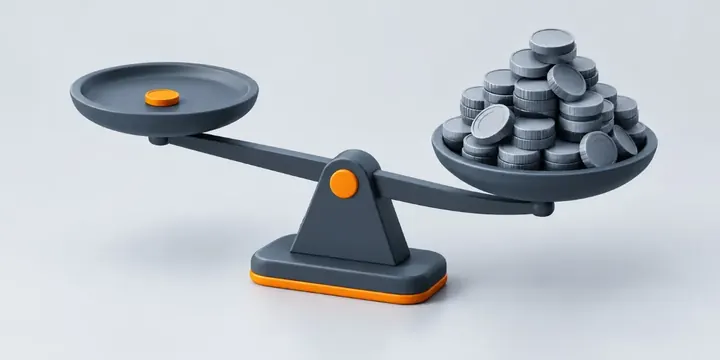
- Over decades, a difference of 1% a year in charges can consume a large share of returns.
- Currency conversion fees on foreign shares are easy to miss.
One-off costs
- Commission: a fixed or percentage fee per trade.
- Spread: the gap between buying and selling prices, wider for smaller companies.
- Taxes on purchase: some countries charge a transaction tax, such as UK stamp duty of 0.5% on most UK share purchases.
- FX conversion: often 0.25% to 1.5% each way when buying foreign shares, depending on the broker.
Ongoing costs
- Fund charges: the ongoing charge figure (OCF) or expense ratio, taken from the fund's value.
- Platform fees: a flat fee or a percentage of what you hold.
- Advice fees, if you use an adviser.
The long-run effect
Suppose $10,000 grows at 6% a year before costs for 30 years. With total annual costs of 0.2%, it reaches about $54,300. With 1.2% a year, it reaches about $40,800. The only difference is the fee. The figures are illustrative arithmetic, not a forecast of returns.
| Annual cost | Net growth | $10,000 after 30 years |
|---|---|---|
| 0.2% | 5.8% | about $54,300 |
| 0.7% | 5.3% | about $47,100 |
| 1.2% | 4.8% | about $40,800 |
Trading costs for active traders
Leveraged products add overnight financing and wider spreads. Frequent trading multiplies one-off costs, which is one reason active strategies struggle to beat low-cost index funds after fees.
Before buying a fund, find its ongoing charge on the key information document and multiply it by the amount you will hold. That is roughly what it will cost you each year.
Reader questions
What is a good ongoing charge for an index fund?
Broad index funds and ETFs tracking major markets are often available with annual charges well under 0.3%, while actively managed funds usually cost more. Compare like with like.
Do I pay fees if the market falls?
Yes. Percentage-based charges are taken regardless of performance.